




Whitelisted Ad Account Explained: Key Benefits (2026)
Two advertisers can run nearly identical campaigns on the exact same budget.
One gets flagged, restricted, or banned within days. The other scales without a single interruption.
The difference usually isn't the creative or the targeting — it's the account itself. A whitelisted ad account changes how the platform treats every ad you run before it even goes live.
Standard ad accounts start with zero trust. Every new campaign gets scrutinized the same way, regardless of how clean your history is.
A whitelisted ad account skips that uncertainty. Platforms like Meta, Google, and TikTok already recognize the account as legitimate, which changes everything about how smoothly your campaigns run.
This guide covers exactly what a whitelisted ad account is, how it actually works, the real benefits it offers, and how to know if your business needs one.
Run on a Whitelisted Ad Account From Day One
Skip the trust-building phase entirely with a Vnox Media agency account built for Meta.
Quick Key Stats on Whitelisted Ad Accounts
Before diving into the mechanics, here's a snapshot of what makes a whitelisted ad account different in practice.
What Is a Whitelisted Ad Account?
A whitelisted ad account is an advertising account that a platform — Meta, Google, TikTok, or Snapchat — has internally flagged with elevated trust status.
Instead of starting from zero like a brand-new personal account, a whitelisted ad account already carries a track record the platform recognizes as legitimate.
That status isn't something you can request directly. It's typically earned through verified agency partnerships, a long history of policy-compliant spend, or formal recognition programs like Meta Business Partner or Google Premier Partner.
Most advertisers access a whitelisted ad account through an established agency rather than building one from scratch, since the vetting and relationship-building process can take months or years on your own.
The term itself borrows from cybersecurity, where a "whitelist" refers to anything explicitly approved rather than blocked by default. Applied to advertising, it flips the usual assumption — instead of proving you're not a risk after the fact, the account starts from a position the platform already trusts.
This distinction matters because most enforcement systems are built to be cautious by default. A brand-new account with no history looks statistically identical to both a legitimate small business and a bad actor, so platforms treat it conservatively until proven otherwise. Pre-established trust removes that ambiguity from day one.
How a Whitelisted Ad Account Works
The mechanics behind a whitelisted ad account come down to trust scoring, not magic.
Why Trust Scoring Matters More Than Ad Copy
Most advertisers assume a rejected ad is purely about the creative or the offer. In reality, the account's underlying trust score often decides the outcome before the review even happens.
Platforms track dozens of signals in the background — account age, billing consistency, login patterns, and historical compliance. A whitelisted ad account arrives with most of these signals already resolved in its favor.
This is also why identical ads can perform completely differently across two accounts. The creative isn't the variable — the account history is.
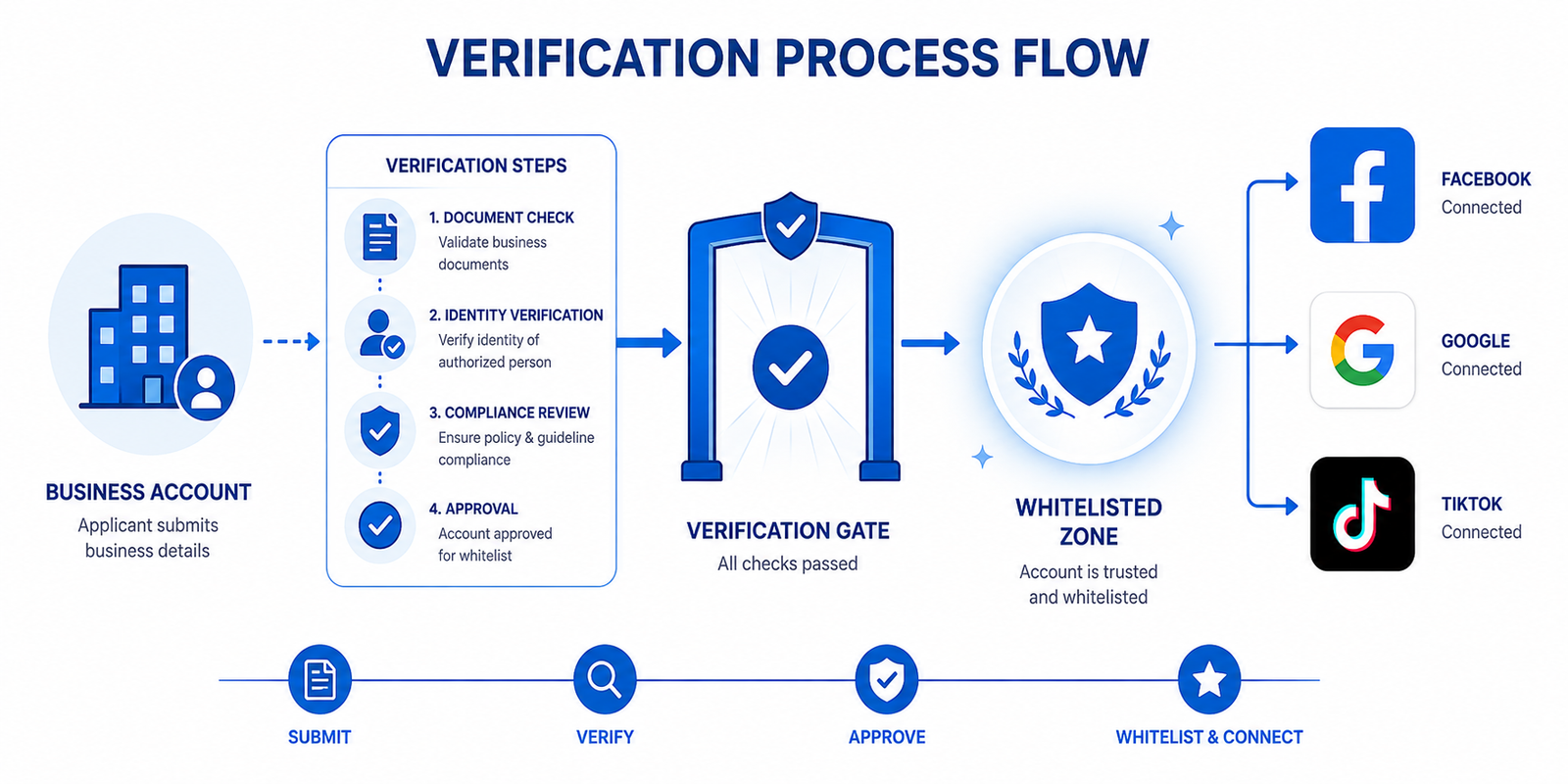
Key Benefits of a Whitelisted Ad Account
Here's how a whitelisted ad account compares to a standard, unverified account on the metrics that actually matter to advertisers.
| Factor | Standard Account | Whitelisted Ad Account |
|---|---|---|
| Ban/restriction risk | High, especially early on | Significantly lower |
| Spend limits | Daily caps common | Effectively unlimited |
| Warm-up period | 2–4 weeks typical | Skipped entirely |
| Support access | General help center | Priority/dedicated rep |
| Recovery if flagged | Days to weeks of downtime | Often instant replacement |
Need a Whitelisted Ad Account for Search Campaigns?
Scale high-intent search traffic without sudden account penalties.
Who Actually Needs a Whitelisted Ad Account?
Not every advertiser needs this level of infrastructure. Small, low-risk spend on a personal account can work fine for a while, especially in low-competition categories with a clean history.
The calculation changes once budget, risk, or downtime tolerance shifts. A whitelisted ad account becomes valuable once any of the following apply to your business.
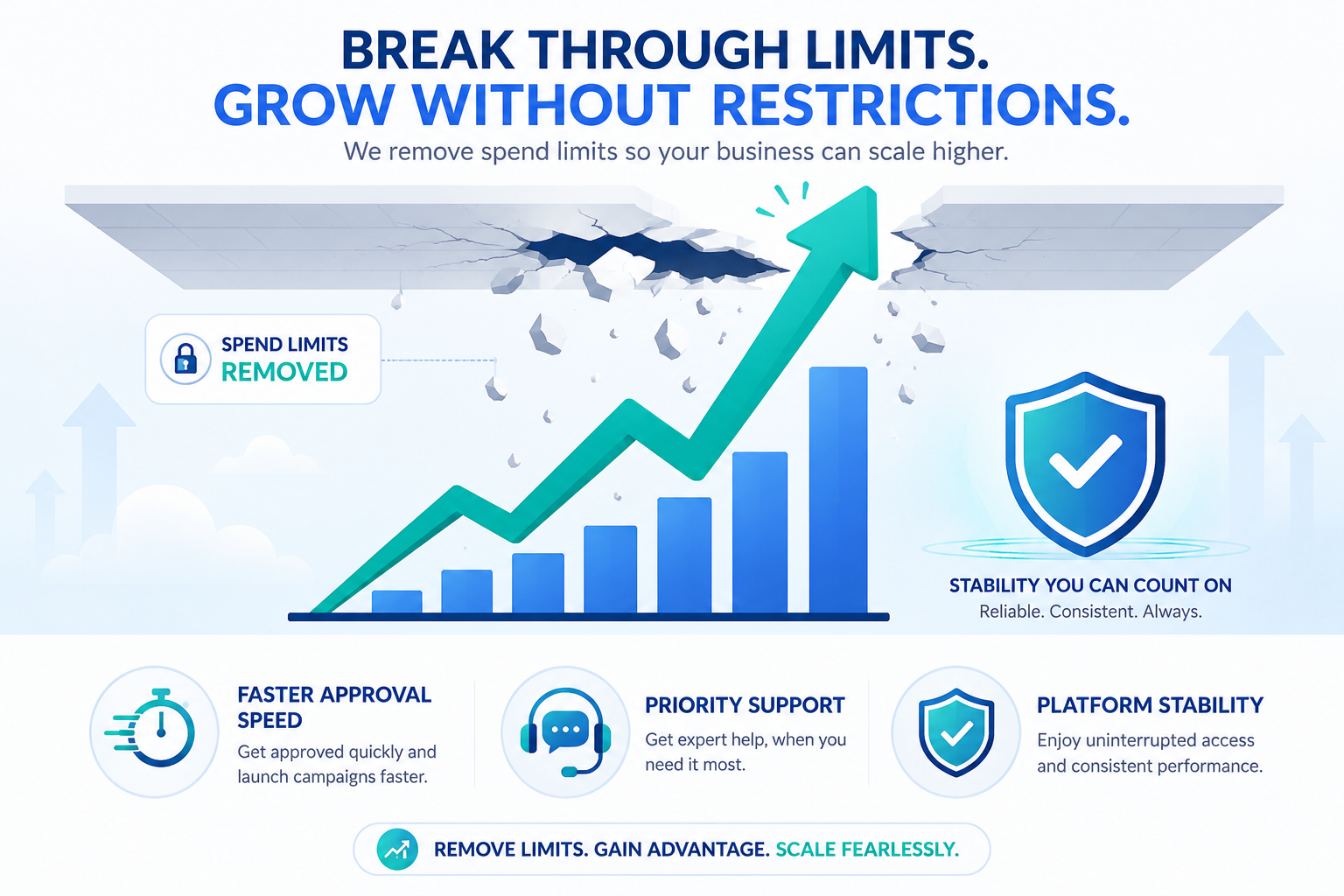
How to Get a Whitelisted Ad Account
Building a whitelisted ad account from scratch on your own is slow, and platforms don't publish a clear application path for individual advertisers.
The realistic route almost every advertiser takes looks like this.
What a Whitelisted Ad Account Actually Costs
Pricing varies widely between providers, and it rarely appears as a simple flat rate.
Most agencies charge either a monthly management fee, a percentage of ad spend, or a hybrid of both. A whitelisted ad account with dedicated support and instant replacements typically sits at the higher end of that range.
It's worth comparing that cost against the alternative: a personal account that gets disabled mid-campaign can cost far more in lost revenue than the premium charged for stable, whitelisted infrastructure.
Be cautious of providers advertising "whitelisted" status at prices well below market rate. Genuine partner-level access is expensive to maintain, and unusually cheap offers are a common red flag for accounts that aren't what they claim to be.
Risks and Limitations to Know Before You Switch
No account type removes risk entirely, and it helps to go in with realistic expectations.
Reduced friction doesn't mean reduced accountability. Platforms still expect campaigns to follow their advertising policies, and repeated violations can affect even a well-established provider's broader account pool.
Provider reliability also varies enormously. Since there's no public certification badge a business can display, due diligence — checking reviews, requesting proof of partner status, and starting with a smaller test budget — matters more than it does with a standard self-serve account.
Finally, ownership and portability deserve attention. Clarify upfront who controls the account, what happens to pixel data and campaign history if you switch providers, and how quickly a replacement account is issued if something does go wrong.
A Real-World Scenario
Consider two e-commerce sellers launching near-identical campaigns for the same product category in the same week.
The first uses a personal profile created specifically for the campaign. Within four days, an automated review flags the account for a spend spike combined with a new billing method, and every ad pauses while the appeal sits in a queue.
The second runs through an agency partner's established infrastructure. The account already carries months of clean spend history across other clients, so the same spend spike barely registers as unusual. Campaigns keep running without interruption.
Neither seller did anything wrong. The difference was entirely in the trust already attached to the account before the first ad ever launched.
Common Myths About Whitelisted Ad Accounts
Misunderstanding what a whitelisted ad account actually does leads to bad decisions. Here are the myths worth clearing up.
"It makes me immune to bans." A whitelisted ad account lowers risk significantly, but severe or repeated policy violations can still trigger a suspension.
"Any provider claiming 'whitelisted' status is the same." Legitimacy varies widely — always confirm real platform partnership status before paying for access.
"It's only for huge agencies." Small businesses scaling fast, or entering high-risk verticals, benefit just as much from a whitelisted ad account as large agencies do.
Scale With a Whitelisted Ad Account Built Right
Stop losing budget to bans and spend caps. Run your campaigns on agency ad accounts built to scale with Vnox Media.
Get Started With Vnox Media →
Conclusion
A whitelisted ad account isn't a loophole or a trick — it's infrastructure built on trust the platform already recognizes.
For advertisers scaling fast, working in high-risk verticals, or simply tired of losing days to random restrictions, a whitelisted ad account removes the uncertainty that standard accounts carry by default.
The businesses that benefit most tend to share one trait: they've already experienced the cost of downtime firsthand, whether through a lost campaign week or a client relationship strained by an unexplained ban. Once that cost becomes real, the case for stable, pre-approved infrastructure stops being theoretical.
Vnox Media provides whitelisted Facebook agency accounts and whitelisted Google agency accounts built on verified partner infrastructure, with instant replacements if anything goes wrong.
Already running ads and not sure if your current setup is holding you back? A quick account health assessment can flag risk signals before they turn into a real problem.
You can also browse Vnox Media's full range of agency ad account solutions across every major platform.
For background on how platforms formally recognize trusted partners, Meta's own Meta Business Partner Directory is a useful starting point.
FAQs
What exactly makes an ad account "whitelisted"?
A whitelisted ad account is internally flagged by the platform with elevated trust status, usually because it sits under a verified agency partner with a strong compliance history.
Can I apply for a whitelisted ad account myself?
There's no public application form. Whitelisted status is typically earned through formal partner programs or accessed through an agency that already holds it.
Is a whitelisted ad account completely ban-proof?
No. It significantly lowers the risk of automated flags, but serious or repeated policy violations can still lead to restrictions on any account.
How fast can I start running ads on a whitelisted ad account?
Through an established provider, most advertisers can be onboarded and running campaigns within a few hours to a day.
Is a whitelisted ad account worth it for a small business?
If you're scaling budget quickly or operating in a restricted category, yes — the reduced downtime risk usually outweighs the cost even at smaller spend levels.
Do I lose access to my pixel or historical data if I switch providers?
It depends on the provider and platform. Reputable partners typically support pixel and audience data continuity, but always confirm this before onboarding — it should be part of the contract, not an assumption.
How can I verify a provider's whitelisted status is genuine?
Ask for proof of formal partner recognition, check independent reviews, and be wary of pricing that looks too low compared to established competitors — genuine access simply costs more to maintain.